Mr. President,
Mr. Secretary General,
Excellencies,
Ladies and gentlemen,
The topic of this year’s debate addresses many current issues that truly present some of the key challenges to affect the future path we tread as a global society. The same is true for international and the individual politics of the countries we come from. Our determination to insist on the common values we have chosen to protect will therefore dictate the success of our common aspirations.
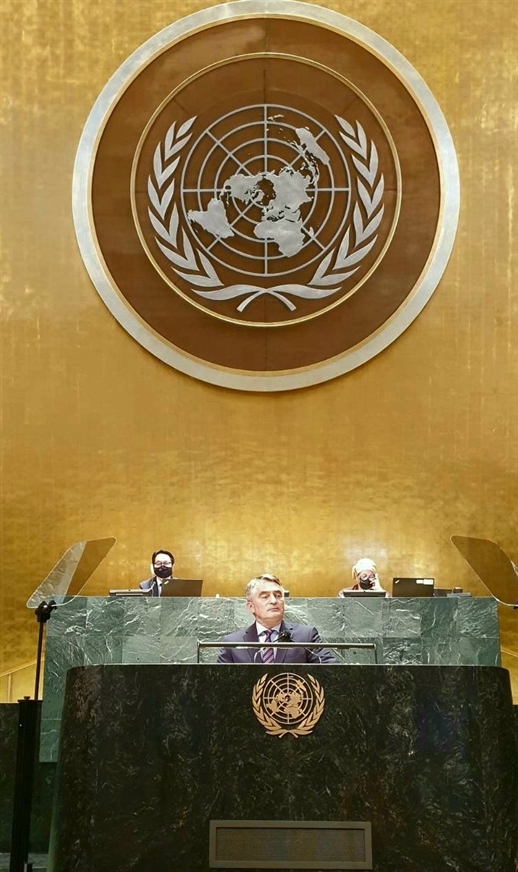
The
COVID 19 pandemic was an important message and a lesson for us on how the
existing international system can be easily shaken, but also how important the
endurance and the resilience of international institutions built on
multilateralism is for them to be able to respond to crisis situations.
Suddenly, international relations were threatened while human rights were
restricted. Multilateralism seemed to have collapsed. The gap between rich and
developed countries on the one hand, and those less developed and not so rich
on the other, has proven to be greater than ever in terms of access to medical
equipment, medicines and vaccines. For the sake of social and economic
recovery, the only thing left under those circumstances was the hope for the
resilience of national economies and health systems, as well as international
institutions and bodies of the United Nations, in order to combat the pandemic
and find and distribute vaccines.
Still,
I would also like to emphasize the importance of bilateral cooperation and
assistance from neighboring or friendly countries, which in many regions,
including my own, were the first concrete aid and sign of solidarity before
multilateral institutions responded to crises that was the COVID 19 pandemic.
That gave us hope and showed the importance of good bilateral relations. It
also justified investing in regional cooperation capacities. I would now like
to commend some of the numerous regional organizations from the Western Balkans
that have helped sustain the economy and facilitate the flow of people and
basic goods under the new circumstances. I am primarily referring to the
Central European Free Trade Agreement and the South East European Regional
Cooperation Council.
The
pandemic has changed the world and affected the achievement of the sustainable
development goals. Under the influence of new circumstances, the SDGs need to
be seen in a whole new light. However, one of the most important issues of
today, closely related to the goals of sustainable development as a need of
global society, is finding answers to the needs of the planet.
Climate
change and global warming, both visible and scientifically proven through the
work of the Intergovernmental Panel on Climate Change, are key issues that also
limit the course of sustainable development. Our activities to slow global
warming and combat climate change are generally not yielding the results we
need to achieve by 2050, warns the 2018 special report. This year’s report
repeats the same warning. Climate change is no longer a matter of warnings from
the scientific community. It is a crisis situation that is already upon us.
Finding answers to climate change is a costly process. It will cost even more
if we do not take the need to accelerate climate change mitigation activities
seriously. We have taken on that commitment because the humankind survival
scenario, along with mitigating the temperature rise, is a value that we must
defend at all costs. We did not choose that value. It chose us.
I
believe that in the long run, this necessary response will cost the less developed and developing countries the most -
the countries which still rely on energy derived from fossil fuels. As a rule,
those groups of countries do not have sufficient capacity or resources to make
a rapid and equitable transition to green energy sources. That will affect
their ability to achieve sustainable development goals in the medium term.
Therefore, financial support for the implementation of the Green Agenda is
extremely important, with contributions from the Conference of Parties of the
United Nations Climate Change Conference as well as regional associations such
as the European Union. In addition to the existing obligations under the Paris
Agreement, the EU also establishes additional standards accepted by countries
such as Bosnia and Herzegovina, in the process of stabilization and association
with the European Union. In my country, Bosnia and Herzegovina, we have about
40% of green capacity for electricity generation. However, gradual shutdown of
thermal power plants, and thus most of the mines, which is expected of us in
the next 25-30 years, will cause a shortage of electricity that can hardly be
replaced in a timely fashion by the green energy capacity, while preserving
rivers and ecological biodiversity, in accordance with international norms. Those
are some of the real circumstances and challenges that we face. I believe that
many other states present here face those as well. However, Bosnia and
Herzegovina stands behind its promise to contribute to reduction of GHG
emissions.
Mr.
President,
One
of the consequences of the slowdown in sustainable development that we are
facing is the outflow of the working age population to developed countries.
According to available statistics, almost 10% of the population has emigrated
from Bosnia and Herzegovina since the last census. Mostly, the working age
population. Young families with children. That is why I would like to draw
attention to the fact that, in addition to the well-known wave of economic
migrants from the Asian Middle East and North Africa, which my country has
faced and tried to provide humanitarian aid, food and accommodation for, we are
also facing an outflow of population. That will cause additional social
problems to our society. Our people are leaving in search of better business
and life opportunities, but also seeking security in orderly societies based on
the active promotion and protection of human rights values. They go after the
perspective of living in an environment where their knowledge and work can
create for them a life in the certainty of a rational social order.
It
is for this reason that I emphasize the protection of human rights as the next
great value. That is a value that we have decided to establish already with the
United Nations Universal Declaration of Human Rights. In Europe, we also have
the European Convention for the Protection of Human Rights and Fundamental
Freedoms, implemented under the auspices of the Council of Europe. In the
European Union, the Charter of Fundamental Rights of the European Union came
into effect in 2009.
Recently,
however, human rights values seem to have been shaken, applied selectively, and
approached on the basis of double standards. I consider such tendencies very
dangerous for the preservation of the human rights protection system.
The
strengthening of ethnic politics in my country, based on exclusivity and
ethno-chauvinist tendencies, along with the rise of religious intolerance and
the collapse of secularism in the Western Balkans region, is a matter of great
concern. Given the 1992-1995 war they have been through, the citizens of Bosnia
and Herzegovina are very sensitive to such social disturbances. Especially
because of the genocide committed in Srebrenica, as determined by the verdict
of the International Court of Justice in The Hague and confirmed by the
judgments of the International Criminal Tribunal for the former Yugoslavia
(ICTY).
I
would like to emphasize here, before you, that I come from a country considered
a successful example of peace-building, but also of maintaining peace and
developing institutions in the context of the United Nations mandate. The
Constitution of Bosnia and Herzegovina is part of an international peace
agreement known as the Dayton Peace Agreement. The United Nations Universal
Declaration of Human Rights and the European Convention for the Protection of
Human Rights and Fundamental Freedoms are also integral parts of our
Constitution. Still, during the last few years, our society has been under
increasing pressure of attempts to degrade basic human and civil rights and
eliminate the individual, the citizen, as a subject of human rights. The
complex system of institutions of Bosnia and Herzegovina based on the Dayton
Peace Agreement makes it difficult to reach a political consensus to move my
country from the Dayton Peace Agreement that stopped the war to a functioning
state with the prospect of becoming a member of the European Union and NATO in
a way that accepts all the values required by democracy, the rule of law and
the protection of human rights and fundamental freedoms.
Mr.
President,
To
point out the selectivity in the application of international human rights
instruments, I would like to reflect on this very important segment of human
rights protection from the point of view of the my country. I believe that we
all share the view that the protection of human rights in all segments of
society is one of the necessary conditions for the creation of stable
democracies, in which peace and prosperity will prevail. However, if we
consider that through the prism of the political system of Bosnia and
Herzegovina, the country I come from, I would like to take this opportunity to
share with all of you a few important elements, which are unfortunately a part
of the other, negative side of this story.
The
General Framework Agreement for Peace, initialed in Dayton and signed in Paris
in 1995, is in force in Bosnia and Herzegovina. An integral part of the
Agreement, as Annex 4, is the Constitution of Bosnia and Herzegovina. In its
preamble, it clearly and unequivocally states that it is, among other things,
based on the Universal Declaration of Human Rights of 1948. It is clear that
accession to the Universal Declaration of Human Rights does not impose a direct
legal obligation on the acceding countries. But, it is certainly a system of
values, which, among other things, aims to create a society within the
countries themselves, but also beyond, based on the equality of every human
being on the planet in their basic human rights.
Unfortunately,
such system of values, based on the equality of all individuals within a
society, does not exist in Bosnia and Herzegovina. I further argue that an
international court, specifically the European Court of Human Rights in
Strasbourg, in its five judgments against Bosnia and Herzegovina, established
the existence of systemic discrimination or systemic inequality of the citizens
of my country. Such inequality is reflected in several aspects of life. That
includes political aspects because all citizens do not have equal rights in the
electoral system, but also those where the same citizens do not have equal
rights and opportunities in social life, such as the right to work. The
political system in Bosnia and Herzegovina is such that it gives preference to
someone’s ethnicity. Based on that ethnicity, the citizens of my country have
greater or lesser rights, depending on which part of the country they live in. On this occasion, I would like to
remind everyone that discrimination based on a person’s ethnic origin is one of
the forms of racial discrimination as set out in Item 1 of the Article 1 of the
International Convention on the Elimination of All Forms of Racial
Discrimination adopted by the United Nations in 1966.
The
complexity of this issue is evident in the attempts to impose on us, even
through diplomatic activities on the international scene, the existence of
discrimination and inequality of the citizens of Bosnia and Herzegovina. That
is done by emphasizing the ethnicity of a part of the citizens and demands for
greater rights for ethnic communities supported by neighboring countries,
always to the detriment of fundamental human rights. This means that collective
rights, which are not part of international legal acts, are being placed above
the human rights of individuals. Please allow me to state that such things are
unacceptable at this moment in time.
Furthermore,
diplomatic activities of various actors call for additional discrimination on
ethnic grounds, in order to create an atmosphere for a process of
self-determination within those ethnic communities. The ultimate goal is the
dissolution or disintegration of Bosnia and Herzegovina and the annexation of
parts of its territory to neighboring countries. That encourages inequality in
human rights, completely devaluing and ignoring the provisions of the Universal
Declaration of Human Rights. Those same factors completely negate the judgments
of the International Criminal Tribunal for the Former Yugoslavia. The judgments
of the Tribunal stated genocide, crimes against humanity, war crimes, ethnic
cleansing and even the existence of joint criminal enterprises where it was
further established that all those most heinous crimes were committed on the
basis of different ethnicities of the citizens of Bosnia and Herzegovina. That
negates one of the fundamental human rights according to the Universal
Declaration, which is the right to life.
Awards
are given to the glorified war criminals, without any moral dilemmas. I
consider that to be in direct contradiction with another value of the United
Nations, which is the elimination of impunity for war crimes. That raises
another question requiring a very clear answer - how to deal with the factors
negating the courts formed by the United Nations? How to treat them in specific
cases of denial of verdicts convicting the perpetrators of the crimes of
genocide, crimes against humanity, war crimes and ethnic cleansing? Can such
factors, which deny those verdicts and hide the perpetrators of genocide and
war crimes, even be a part of the international legal order? That question
directly goes back to the foundations of international law and the United
Nations organization itself.
At
the same time, the principles of universal jurisdiction are abused for
political purposes, outside of the prescribed procedures and agreements
concluded between the states that clearly specify the modalities of persecution
of war crime suspects who inevitably must be held accountable. Those war crime
suspects have citizenships of the countries which hold the primary
responsibility for this. If universal jurisdiction is used in a selective and
political way, that deeply compromises the principles of criminal law and legal
security, and thus human rights. It also undermines confidence in judicial
mechanisms.
On
the other hand, certain politics, by means of forcing discrimination and
inequality of the citizens of Bosnia and Herzegovina, attempt to invade the
constitutional and legal system of my country, in order to get a “Golden Key”
or “Golden Share” in managing and making decisions in the country. Under all
acts of international law, such as the Charter of the United Nations, they
should not be allowed to do so. Their tendencies in the diplomatic field, where
they deny the fundamental human rights of individuals in order to achieve their
clear goals by means of certain imaginary collective rights, go beyond good
neighborly relations. Such activities and intentions hide the strategic goal of
appropriating parts of the territory of Bosnia and Herzegovina.
All
those tendencies are based on the visible neglect of human rights established
by a number of international acts, such as the Universal Declaration of Human
Rights. Their politically dangerous goals are very much behind all this,
leading to daily destabilization of the region of the Western Balkans. Such
political goals are directed towards the territory of Bosnia and Herzegovina.
That is evident in their efforts to force inequality among citizens on the
basis of ethnicity, which, to remind you once again, is a form of racial
discrimination, and the efforts to create ethnically pure territorial units. I
am telling you all this to show on real examples of how the neglect of human
rights and creating an environment of inequality among citizens, individuals,
can have political agendas, which lead to destabilization of entire regions in
the world, such as the Western Balkans. Apart from the fact that something like
this is completely unacceptable, it is also very dangerous.
Mr.
President,
Distinguished
colleagues,
I
mention this situation in my country in the context of the importance of the
mechanisms of the United Nations. By means of two resolutions, the UN
established the institution of the United Nations High Representative in Bosnia
and Herzegovina, to take care of the implementation of the Dayton Peace
Agreement. Thus the obligation of the United Nations itself to protect the
international order, through the protection of acts of international law. One
of those acts is the Universal Declaration of Human Rights. Therefore, I
believe that this is the right place to emphasize the expectation that the new
High Representative of the international community in Bosnia and Herzegovina
will take into account the need to protect international legal acts and their
fundamental values. That is one of his most important tasks. Otherwise, if the
international community itself in Bosnia and Herzegovina wants to abandon the
implementation of the Universal Declaration of Human Rights, then the following
question rightly arises - is the Universal Declaration even necessary if its
implementation is selective? Should we even talk about the protection of human
rights in general if, in the specific case of Bosnia and Herzegovina, where the
United Nations still has an executive mandate through the Office of the High
Representative, we do not show by example that we are ready to stand for common
values such as protection of human rights and equality of every citizen in
relation to someone else and different.
I
believe that, despite all the differences of political views within Bosnia and
Herzegovina, including the international community represented by the Peace
Implementation Council in BiH, which assists the High Representative, the only
guiding light to further political development of my country, as a pledge to
preserve its peace and future, must be respect for human rights values. All the
people of my country, regardless of their identity, ethnicity, religious
affiliation or absence thereof, must have the same rights. Otherwise, we will
end up in an “Orwellian society”, where it is accepted that some are, after
all, more important than others. That always jeopardizes the stability of a
society and undermines peace and security. From this very place, I call upon
the United Nations institutions to insist on the values of human rights
protection in every segment of their activities.
Mr.
President,
Finally,
I would like to express my support for the efforts of the Secretary-General,
who, with the help of his services and the UN agencies, has managed to preserve
the role of the United Nations in these difficult circumstances of the
pandemic. Also to you, President, for your effort this year to provide a live
opportunity to exchange views on current world problems reflecting also on our
social activities in the countries we come from.
I
believe we will next year have a General Debate under better epidemiological
circumstances. That certainly requires us to promote the necessity of
vaccination as the only scientifically proven way to avoid fatal consequences
for human health, but also severe economic consequences for the society.
Thank
you