Mr. President, distinguished members of the Council,
I thank you for the opportunity to address you at this decisive moment for Bosnia and Herzegovina and, indeed, for the credibility of the international system we all rely on.
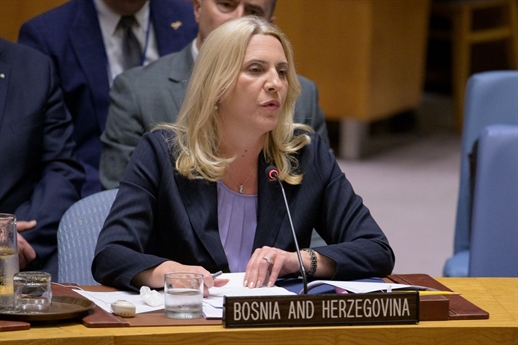
Although I currently chair the tripartite
Presidency of Bosnia and Herzegovina, I speak to you today in my constitutional
capacity as the Serb member of that Presidency—elected by the citizens of
Republika Srpska, one of two constituent entities that comprise BiH.
The Dayton agreement was not a perfect
solution, but it was an act of courageous diplomacy that balanced three peoples
and two entities in one state. It was -
and remains, a legally binding treaty, lodged in the annals of this
Council, whose Annex 4 is our Constitution and whose Annex 10 defines the
mandate of the High Representative.
It created a decentralized, consensus-based
system precisely so, that no single actor—domestic or foreign—could dominate
the others. Yet today, that balance is being hollowed out by unaccountable foreign
intervention either through the
actions of various high representatives or foreign judges in the Constitutional
Court of BiH.
Allow me to begin
where Dayton begins: with the rule of law. Annex 10 is clear when requiring
that the High Representative shall be approved by the UN Security Council. This
has never happened in Mr’ Schmidt’s case. He was selected by the self-appointed
Peace Implementation Council—an informal assemblage with no charter basis, no
treaty or legal authority, and no power to override this body. And he has acted
based on the so-called Bonn powers that are not codified in
any legally binding international instrument.
Some claim that
because the PIC “informed” the Council of its selection, confirmation became
unnecessary. But if this Council’s vote were unnecessary, Annex 10 would never
have required it.
Annex 10 is also clear
about the mandate of the High representative. The
Dayton Agreement did not authorize the High Representative to legislate, to
suspend constitutions, to criminalize elected officials and political parties,
or rule by decree.
Yet, that is precisely what Mr.
Christian Schmidt and some of his predecessors have done many times.
Here lies the heart of
a continual crisis in Bosnia whose culmination we are witnessing today.
Everything that flows from that irregularity – lack of UN Security Council
confirmation and unlawful impositions beyond the mandate set forth in Annex 10,
is infected with the same defect. No legal system—domestic or international—can
survive if the interpreters of the rules exempt themselves from the rules.
Let me briefly mention
only some of numerous edicts Mr. Schmidt unlawfully issued since arriving in
BiH.
1.He unilaterally suspended the
Constitution of the Federation of BiH to impose a government he preferred,
ignoring the election results.
2. He altered the electoral law
bypassing democratic parliamentary procedures,
3. As well, he extended the mandate
of the Central Election Commission without legislative approval.
4. He amended the criminal code to
criminalize non-compliance with his own decrees—a move to primarily eliminate
from political life a democratically elected president of Republika Srpska for
fulfilling his constitutional duties to sign laws passed by the National
Assembly of Republika Srpska, but also to intimidate any dissenting officials
who would dare challenge his illegitimate rule.
5. He cut public funding to the
democratically elected political parties in Republika Srpska cancelling the
political will of the vast majority of its voters.
Esteemed members of the Council,
This is neither the
Dayton Agreement, nor a democracy, and certainly not the rule of law. It is
dictatorship—government by decree, unchecked by courts, devoid of appeal. What
started as mere overreach has now solidified into a system of repression.
Each action was
justified in the name of “functionality.” Yet the result is not a more cohesive
Bosnia; it is a deeply polarized country which can hardly survive this form and
extent of foreign intervention.
When Republika Srpska protests such
violations, we are unjustly labeled as separatists. However, demanding
adherence to international treaties is not separatism.
Contrary to some narratives,
Republika Srpska is not undermining the Dayton Agreement—it is upholding it.
Our demands do not seek to dismantle Bosnia and Herzegovina but rather to
restore the legality and balance originally enshrined in the Dayton framework.
For this reason, the National
Assembly of Republika Srpska has enacted legislation to defend its rights
within Dayton. These measures are not provocations; they are lawful responses
to persistent violations of international law.
The ongoing crisis is neither of
Republika Srpska’s making nor in its interest. It has been triggered by Mr.
Schmidt’s most expansive and authoritarian use of power, burdening the country
with a series of unlawful impositions
Therefore, condemning Republika
Srpska’s actions without first addressing Mr. Schmidt’s unlawful interventions
is not only misleading but dangerously one-sided.
Allow me to state our position plainly:
1.We remain fully committed to the sovereignty and territorial integrity of
Bosnia and Herzegovina as defined by Dayton.
2. As for the mandate
of the High Representative, we seek to place it back on its legal foundation,
which is Annex 10, and prepare for the closure of the OHR’s
3. We reject
unilateral decrees that rewrite the treaty, criminalize debate, persecute
political opponents through a weaponized judicial system, discriminate
political parties or suspend the will of voters.
A legal reset in Bosnia is a logical
next step if we want to prevent escalation or successive future crises.
Therefore, I
respectfully call on this Council to take some immediate steps:
1. Schedule a formal vote on Mr. Schmidt’s confirmation. If he cannot pass the
vote, let us find another candidate who can and who
will be appointed in accordance with annex 10.
2. Establish an independent legal review,
under Security Council auspices, of the conformity of the so-called “Bonn
powers” with Annex 10 and the UN Charter.
3. Encourage all BiH stakeholders to engage in a dialogue aimed at preventing
further crises and revitalizing functional governance.
We are prepared to participate constructively,
transparently, and in good faith.
Mr President, members of the Council,
The Dayton Agreement ended a devastating war
and laid the foundation for our constitutional system. It deserves respect, not
manipulation and breach of its procedures.
Let us together ensure that Bosnia’s future is
written not by decree, but by law.
On a separate but critical note, I want to
clarify an issue. As a member of the Presidency of Bosnia and Herzegovina, I
have been forced to engage directly with your missions due to obstruction by
the BiH Ministry of Foreign Affairs. This ministry selectively restricts my
diplomatic correspondence while granting unrestricted access to my Bosniak
colleague. This bias extends even to Bosnia’s Permanent Mission to the United
Nations.
Such actions demonstrate the reality of
the state we are being asked to accept—a system where power is centralized,
constitutional rights are disregarded, and even the fundamental ability to
communicate is manipulated for political ends.
I thank you for your attention and remain
at your disposal for any questions.