Honourable Deputy Secretary General, dear Radmila, esteemed ambassadors, ladies and gentlemen,
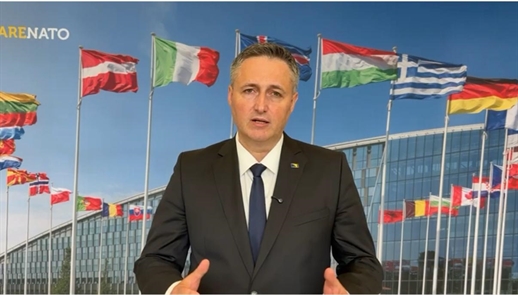
at the beginning of my address, as the Chairman of the Presidency of Bosnia and Herzegovina, I wish to express gratitude to NATO for its enormous contribution to establishing and preserving peace and stability in Bosnia and Herzegovina.
The strong ties between Bosnia and Herzegovina and NATO are also
stipulated by the Dayton Peace Agreement.
No country outside the Alliance has such strong ties with NATO as Bosnia
and Herzegovina.
In Bosnia and Herzegovina, there is full institutional consensus
regarding NATO membership.
The competent state institutions of Bosnia and Herzegovina have adopted
all necessary legal, strategic, doctrinal and operational documents in the
field of defence and security.
It is the obligation of the state institutions to implement all
necessary activities for the admission of Bosnia and Herzegovina into NATO
membership.
It is important to emphasise that there is also strong public support
for NATO membership.
Around 70% of the citizens of our country want Bosnia and Herzegovina to
become a NATO member.
Therefore, support in our country is higher than it was in neighbouring
countries in the region at the time they became NATO members. Comparatively
speaking, in some countries that support barely exceeded 50%.
These facts are far stronger than the irresponsible statements of
certain destructive politicians who attempt to deny the institutional consensus
and the majority will of the citizens of Bosnia and Herzegovina.
Ladies and gentlemen,
Over the past two decades, Bosnia and Herzegovina has made significant
progress towards NATO membership.
Our path so far has been gradual, but consistent. I will mention some of
the achievements:
-
accession to the Partnership for Peace in
2006;
-
adoption of strategic documents (Security
Policy, Defence Policy, Defence Review…) which continuously confirm the strong
commitment of Bosnia and Herzegovina to Euro-Atlantic integration;
-
participation in numerous NATO programmes and
exercises;
-
participation in international peace support
operations;
-
enhancement of interoperability, from the
activation of the Membership Action Plan to continuous cooperation through
annual national programmes (that is, the Reform Programme of Bosnia and
Herzegovina).
On its path towards NATO membership, Bosnia and Herzegovina has achieved
important and concrete results.
Among other things, the state authorities have:
-
adopted six annual Reform Programmes of
Bosnia and Herzegovina, which were submitted to Brussels, while preparations
are underway for the adoption of the 2026 document;
-
adopted the Individually Tailored Partnership
Programme for the period 2025–2028;
-
adopted multi-year projects for the
modernisation of the Armed Forces of Bosnia and Herzegovina (AFBiH), including
pilot training, procurement of helicopters, uniforms, armoured personnel
carriers and ammunition;
-
increased budget allocations for defence
(over the past three years by more than 150 million BAM), which has resulted in
strengthening operational capabilities and improving the standards of AFBiH
personnel;
-
adopted documents and standards for
prioritising future infrastructure investments, with the aim of ensuring more
efficient use of resources.
In addition to the above, it is important to emphasise that in the past
several years we have:
-
strengthened the operational capabilities of
the AFBiH (in both personnel and material-technical terms), which includes the
establishment of a reserve component within the Ministry of Defence of Bosnia
and Herzegovina and the AFBiH, the training of 27 young pilots over the
previous two years, as well as an additional 12 during 2026 and 2027, which is
several times more than during the previous ten years;
-
intensified activities aimed at implementing
the modernisation plan of the AFBiH, within which funds have been secured for
the financing and implementation of projects worth more than 200 million euros
(donor funds amount to more than 165 million euros, while around 35 million
euros are from the budget);
-
strengthened bilateral and multilateral
cooperation activities with key allies and partners, which also resulted in the
signing of a number of important agreements;
-
improved decision-making procedures within
the Presidency of Bosnia and Herzegovina, which enabled more efficient
assistance to civilian structures in cases of natural disasters and emergencies
(more than 50 decisions were adopted for the engagement of AFBiH resources);
-
intensified the participation of AFBiH
personnel in international exercises. In the period from 2023 to 2026, AFBiH
personnel participated in 261 NATO-organised activities;
-
intensified activities aimed at implementing
projects for strengthening professionalism and ethics, as well as NATO
programmes in the field of integrity building.
Also, we should not forget that we have:
-
actively participated in international peace
support operations;
-
continued mine action activities, with the
AFBiH contributing more than 30% to the overall demining effort in the country.
Over the past three years, 39 million square metres of land have been cleared
of mines and returned for civilian use. Approximately 1.5% of the territory of
Bosnia and Herzegovina still remains contaminated. More specifically, 1,553
mines have been removed;
-
responsibly continued the disposal and
management of surplus unstable and obsolete ammunition. Significant progress
has also been achieved in this segment over the past three years and, in
accordance with the decisions of the Presidency of Bosnia and Herzegovina, more
than 361 tonnes of unstable ammunition were demilitarised in the period
2023–2025;
-
declared and evaluated the AFBiH Light
Infantry Battalion Battle Group, which was successfully assessed by NATO;
-
successfully hosted the NAC visit to Bosnia
and Herzegovina in 2024;
-
successfully organised the NATO Partner 360
Symposium 2024 as hosts;
-
and ensured that Bosnia and Herzegovina was
invited for the first time to contribute to the NATO Response Force, that is,
high-readiness forces capable of rapid deployment at short notice.
I am pleased that today I can also mention positive examples that will
contribute to strengthening the energy security of Bosnia and Herzegovina.
Activities are underway to finalise the important strategic project of
the Southern Gas Interconnection, whose overall significance goes beyond the
borders of Bosnia and Herzegovina.
By diversifying energy sources, we are strengthening our economy,
overall security and resilience, as well as strategic partnerships.
The economic strengthening of Bosnia and Herzegovina directly
contributes to its security, reduces the space for destabilisation and
increases society’s resilience to both external and internal pressures.
Ladies and gentlemen,
Our results would have been even better had there not been destructive
and anti-Dayton activities.
Unfortunately, for years the leadership of the Bosnian entity Republika
Srpska has been undermining the Dayton Peace Agreement and openly working
against the Euro-Atlantic integration of Bosnia and Herzegovina.
The year 2025 was particularly challenging, when we faced open attempts
to dismantle the constitutional order of Bosnia and Herzegovina. Nevertheless,
thanks to responsible and institutional action, the worst-case scenario was
avoided.
The dangers have not disappeared in 2026 either.
The leadership of the Bosnian entity Republika Srpska continues to
threaten peace and stability in Bosnia and Herzegovina.
Hybrid activities have also intensified, primarily manifested through:
-
the spread of disinformation;
-
cyber attacks on critical infrastructure;
-
propaganda activities;
-
foreign malign influence aimed at
destabilising state institutions and undermining the constitutional order;
-
and the activities of Russian state media
outlets, such as Sputnik Serbia and Russia Today, which regularly disseminate
anti-NATO and anti-EU content, promote political narratives close to Moscow and
emphasise ethnic divisions in Bosnia and Herzegovina.
We must not ignore these threats, as they may have serious consequences
for the stability and security of Bosnia and Herzegovina and the region.
In the coming period, we must maintain a high level of vigilance,
further strengthen the resilience of institutions and society as a whole, and
improve coordination mechanisms with international partners.
It is particularly important to continue reforms in the fields of
security, judiciary and public administration, in order to respond to
contemporary threats, including hybrid challenges and disinformation.
At the end, I would also like to offer several concrete proposals aimed
at accelerating Bosnia and Herzegovina’s NATO path.
I believe it is extremely important that:
Bosnia and Herzegovina be even more firmly institutionally incorporated
into the Alliance’s security framework. This includes, among other things, an
enhanced NATO presence in Bosnia and Herzegovina, the adoption of a strategic
concept that strengthens security guarantees for Bosnia and Herzegovina, as
well as the development of concrete political and military action plans for
crisis situations;
the operational and advisory presence of NATO in Bosnia and Herzegovina
continue;
the integration of Bosnia and Herzegovina into NATO be accelerated
through the creation of new mechanisms, supplements to the Reform Programme of
Bosnia and Herzegovina, which would help remove obstacles and speed up the
integration process;
Bosnia and Herzegovina be provided with a clearly defined and credible
confirmation of its NATO membership perspective. I remind you that Bosnia and
Herzegovina has formally and substantively fulfilled all conditions to receive
an invitation for NATO membership;
NATO, through strategic communication, continue emphasising that the
security and political stability of Bosnia and Herzegovina are in the interest
of the Alliance;
in the event that the extension of the EUFOR mission in Bosnia and
Herzegovina is prevented, NATO prepare a response in accordance with Annex 1-A
of the Dayton Peace Agreement. A security vacuum in Bosnia and Herzegovina
could have catastrophic consequences.
In addition to the above, I propose that:
through joint measures, the resilience of Bosnia and Herzegovina to
hybrid threats be strengthened through more concrete support and stronger
connectivity with NATO in terms of strategic communication and cyber security
in Bosnia and Herzegovina;
cooperation in the field of energy security be intensified in order to
reduce dependency and increase resilience;
the strengthening of AFBiH capacities continue through NATO support
packages;
and the participation of AFBiH personnel in NATO training programmes and
international exercises continue.
Esteemed members of the North Atlantic Council,
Bosnia and Herzegovina remains a reliable partner that understands
contemporary security challenges.
We are aware that NATO membership is not only a privilege, but also a
serious responsibility.
We are convinced that strengthening the security of Bosnia and
Herzegovina simultaneously strengthens the security of the entire Southeast of
Europe.
Therefore, I call upon you to support Bosnia and Herzegovina even more
strongly.
Our path is clearly defined, and our strategic goal remains NATO
membership.
Thank you for your attention.