This morning I would like to talk about these three issues: 1) the vision of Bosnia and Herzegovina's future within the European Union; 2) the steps we have made in order to turn this vision into reality, and, when I say “we“, I refer to the EU and Bosnia and Herzegovina together; 3) the threats and challenges we have been faced with, and how we can oppose them together.
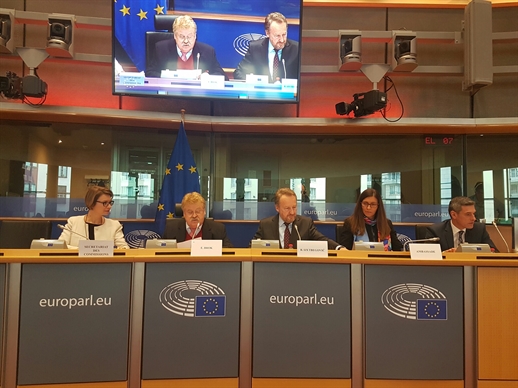
Esteemed members of the European
Parliament,
Mr Brok,
It is always my pleasure to be in
Brussels – particularly in the European Parliament, where there are so many
friends of Bosnia and Herzegovina. I extend my thanks to all of you for this
opportunity to share views with you.
This morning I would like to talk
about the following three issues:
1) The vision of Bosnia and Herzegovina's future within the European Union;
2) The steps
we have made in order to turn this vision into reality, and, when I say “we“, I
refer to the EU and Bosnia and Herzegovina together;
3) The threats and
challenges we have been faced with, and how we can oppose them together.
For a moment, let me bring you
back to 6 February 2014, when the European Parliament in Strasbourg adopted its
annual Resolution on Bosnia and Herzegovina. You set out in that Resolution your
deep concern due to „a lack of shared vision on the future of Bosnia and
Herzegovina expressed by the political leaders“.
A day later, on 7 February 2014,
the citizens of Bosnia and Herzegovina gathered in the streets to protest
against the hardship social and economic situation and request from us, their
elected leaders, to offer a vision of the future of Bosnia and Herzegovina, as
well as to make concrete steps needed to turn that vision into reality.
Ten days later, Mr Štefan Füle, EU
Enlargement Commissioner at the time, arrived to Sarajevo with a conclusion
that there would be no agreement achieved by the political leaders of Bosnia
and Herzegovina on the implementation of the European Court for Human Rights'
judgement concerning the case of Sejdić and Finci versus BiH. This did not happen
because we had not been trying sufficiently. Namely, in the course of almost
thirty months, we held more than 150 meetings, at which we discussed over 50
various suggestions. We did not manage to reach an agreement because some of
the participants of these negotiations were expressing a mix of populism and alienation
from the actual needs of our citizens. Therefore, it came as no surprise that
Mr Füle stated, pursuant to our last meeting, that the political leaders of
Bosnia and Herzegovina “had to act more responsibly to address the citizens'
needs“ – ensure more new jobs, more justice and better life standard.
In the weeks and months that
followed the protests held in February, we held numerous meetings with various
representatives of the academic community, civil society and businesspersons
throughout Bosnia and Herzegovina. When friends from the EU capitals or
Brussels visited us in Sarajevo and asked how they could help and what kind of
assistance they could provide us with in order to ensure that we start moving
forward, we told them what we understood through those meetings and encounters
– that it was in the interest of Bosnia and Herzegovina and all her citizens
that we should focus on the two issues: social and economic reforms and
convergence in the European Union.
The idea was simple: that we
dedicate ourselves to the actual needs of our citizens through the
implementation of difficult social and economic reforms, while hoping that, pursuant
to progress that we would achieve due to such reforms, it would also be easier
to achieve agreements on the issues such as the implementation of the Sejdić –
Finci judgement. Our friends from Croatia, Slovenia and other EU countries
helped us present this argument throughout the EU. In November 2014 Germany and
Great Britain officially proposed to other EU members the so-called “renewed EU
approach“. In December 2014 their proposal was supported by all 28 member
states, and it became the official EU policy then.
And, what has happened since then?
In short, Bosnia and Herzegovina
returned to the EU accession path, and achieved more progress on that path in
the previous 18 months than in the entire previous decade. The renewed EU
approach enabled us to achieve such progress. We did the job ourselves in
Bosnia and Herzegovina, and the EU provided us with its invaluable support.
Mr Ivanić and Mr Čović, my
colleagues in the Presidency of Bosnia and Herzegovina, and Id I initiated progress
along that path by preparing the “Declaration on commitment to reforms within
the EU accession framework“. It was not an easy task to gather the leaders of
all 14 parliamentary political parties in order to ensure their agreement on
the content of the declaration concerned. Our good friend Federica Mogherini,
EU High Representative, who was with us in Sarajevo on the day when this
declaration was adopted by the Parliamentary Assembly of Bosnia and
Herzegovina, referred to that adoption as “a historic step in the right
direction“.
The three of us in the Presidency
agreed that it was our task to ensure that Bosnia and Herzegovina would keep
moving forward in the set direction. The Chairperson of the Council of Ministers
and the two entity prime ministers conducted very intense negotiations for
months on the content of the social and economic reform agenda for the
period from 2015 to 2018. Taking into consideration
the lessons learnt from the previous experience, particularly concerning the
need to enhance functioning of the labour market and the structure of the budget
expenditures, we agreed on a comprehensive Reform Agenda, which promised most
significant redirection of our economics since the time of the Dayton Peace
Accords – from enhancement of the
business climate to the reform of labour legislation, from the health care system
reform to the implementation of a comprehensive pension system reform and more
efficient collection of taxes. The content of the Reform Agenda was drafted in
close cooperation with the IMF, the World Bank, and the EBRD. These
institutions have provided their financial support to the implementation of the
Reform Agenda. The European Commission has established that significant results
have been achieved already due to the implementation of the Reform Agenda.
One such result was a significant
increase of economic activity. Bosnia and Herzegovina is the most rapidly
growing economy in our region at the moment. The GDP increase of in 2015 was
3.14%, which was twice as much in relation to 2014. We expect the GDP growth
rate to remain at 3% this year, with a possible rise to 4% in the mid-term
period. The revenue from indirect taxes has grown by 3%. The industrial
production has increased by 2.2%. The unemployment rate has fallen by 4.4% in
relation to the previous year.
We have also made significant
steps towards convergence in the EU. The
Stabilisation and Association Agreement came into effect in summer 2015. In
February 2016 Mr Dragan Čović, my colleague filed our application for
membership in the EU. In September 2016 the EU member countries accepted our
membership application as a credible one. We are delighted that we will host
Commissioner Hahn in Sarajevo on 9 December, when he will hand over the
European Commission's questionnaire, which will assess our readiness for
obtaining the candidate status. Let me assure you that completing the questionnaire
will be the priority for all administrative levels in BiH because we want to
receive an opinion from the European Commission as soon as possible on our
readiness for the candidate status. That opinion will help us realize to which
extent our institutions, legislation and practice deviate from the EU
standards. Businesspersons and civil society representatives keep telling us
that they see achieving the EU standards as a priority. Our citizens want to
buy quality goods and services in accordance with the EU quality standards.
Business companies and investors want to see legal security and the EU
standards applied in BiH because that will enable them to do business with the
EU in an easier and more simple way.
Dear friends,
I am not here to show you a pink
image of today's Bosnia and Herzegovina, or to assert that a bright future is granted.
We have been faced with many challenges and we have had many open issues. The political
relations are still very fragile. The level of trust is not satisfactory yet.
Instances of turbulence occur almost daily. To achieve the current progress has
not been easy at all, and the path ahead will bring about even more challenges.
Therefore, I believe that we should proceed along this path cautiously, while
making sure that we do not jeopardize what has been achieved so far.
I believe that most of you will
agree that mobilizing such political forces which will resist the growing
populism, as well as winning our citizens' sympathy and support for such
resistance, have never been more difficult than now. Support provided by some third countries to populists
throughout the EU countries, as well as throughout the countries striving to join
the EU, has been much stronger nowadays than it used to be a few years ago.
They are not interested in any facts or in the long-term impact their actions will
have to our societies.
In the EU member states these forces
have been directed against the EU and our shared values. In Bosnia and
Herzegovina they have been directed against the constitutional order, sovereignty
and territorial integrity, as well as against our goal to reach the destination
preferred by 80% of our citizens – i.e. the family of Euro-Atlantic states. In
the RS entity such actors conducted a referendum by which the Decision of the
Constitutional Court was flagrantly breached, the constitutional order was
challenged, the Dayton Peace Accords was breached, and a serious threat to
security and stability of BiH was posed. We have been faced with the populist
forces which have obstructed adoption of the social and economic reforms. While
playing the card of ethnic differences, some of these populists have also
raised inter-ethnic tensions by making unfounded statements on their endangered
vital national interests. They want to
return us to the counter-productive and polarizing debates on constitutional
reforms. We should not let them prevail!
The struggle against these growing
forces can only be won if we oppose them together. Therefore, I firmly support the
decision of the EU member states to accept our application for membership. We
also appreciate all the assistance which we have received from the EU
institutions and individual EU member states in order to enable us to meet the
conditions we were given. Such support is very important because it sends a
strong message to those political actors who have received support from the
third countries to work against our shared future in the EU and NATO.
Dear members of the European
Parliament,
In view of Bosnia and
Herzegovina's accession to the EU, I want to share with you what I believe is
realistic for us to achieve in the next 12 to 18 months.
First, we will complete the
European Commission's questionnaire.
Second, we will intensify the
implementation of the Reform Agenda.
Third, through the Coordination
Mechanism adopted this summer, all administrative levels in our state will
agree and adopt the state-level strategies in the fields of transport, energy
and agriculture – in order to enable us to, finally, start using the
pre-accession EU funds.
Fourth, as soon as the European
Commission prepares its opinion on our readiness, we will work in accordance
with that opinion towards achieving the candidate status. Our goal is to
achieve the candidate status by the end of 2017.
And fifth, there is a possibility
that we will reach an agreement on the implementation of the Sejdić-Finci case.
That agreement could also take into account some legitimate remarks made by the
Bosnian and Herzegovinian Croats. However, let me be honest with you. I fear
that, despite urgency, it will be very difficult to agree on these issues
because it is necessary to win a two-third majority in both houses of the State
Parliament, gathering the representatives of 14 different political parties.
It would be of huge assistance to
us if the implementation of the judgment on Sejdić-Finci case is not posed as a
firm condition to our accession to the EU. I invite all in the EU to cautiously
proceed, while thinking strategically which particular approach would bring
about best results for all of us. It is my suggestion that all constitutional
issues should be considered within the framework of opening chapters on
negotiations for our EU membership. Wider constitutional reforms, which fall
out of the framework of the Sejdić-Finci judgement implementation, are neither
desirable nor doable at this moment because the key political actors in BiH
would simply not be able to reach an agreement on their scope and content. In
the next two years we will have to focus on the social and economic reforms,
building of transport infrastructure, public administration reform and
strengthening of the rule of law. These are the issues that the citizens need addressed,
and that is what they expect from us.
Dear friends,
I would now like to talk about the
contribution of Bosnia and Herzegovina to promoting our shared values, vision
and objectives in the domain of foreign and security policy. This morning you
shared views with High Representative Mogherini on the implementation of the
Global EU Strategy. Bosnia and Herzegovina is fully committed to the principles
and priorities set out in the Strategy, and will contribute to its
implementation to the extent in which she can do so as a potential candidate
state. We will accept our part of responsibility for facing security threats
and challenges that Europe is facing nowadays.
We have been committed to the
fight against terrorism in all its forms. As a member of the Global Coalition to
Counter ISIL, we will continue to contribute, within our capabilities, to the international
efforts invested in degrading and defeating this terrorist organization. We are
the first country in the region which adopted the amendments to our Criminal
Code in order to establish legal sanctions against fighters who fight wars abroad.
Our legislation has been additionally strengthened in its segments concerning the
prohibition against the financing of terrorist activities.
Terrorism is a threat which has affected
all of us. No single country or society has been immune to that threat, and no
single country can oppose it on its own. Terrorism has become a growing
challenge which requires a comprehensive reply based on cooperation of all
states not only through security measures, but through preventive measures, too.
Those who conduct, organize or encourage
terrorist attacks, while claiming that they do it in the name of Islam, act
absolutely contrary to the values of Islam and its universal principles of
tolerance and coexistence. Violent extremism and terrorism are entirely
unacceptable from the point of view of Islam. Terrorism in the name of Islam is
terrorism against Islam.
Stability and security of the
Western Balkans, and its ultimate consolidation within the EU framework are of Bosnia
and Herzegovina's top strategic importance. We will continue to cooperate
closely with the EU and the countries in the region in view of achieving these
shared objectives. To that end, we very much appreciate and commit ourselves to
regional dialogue and cooperation. We will continue to participate actively in
all frameworks and mechanisms of regional cooperation with the EU, particularly
through the Berlin Process. The instance of regional cooperation on projects of
infrastructural connectedness builds trust, improves relations, and offers
palpable economic benefit to our citizens.
However, political leaders in the
region, from time to time, continue to use such rhetoric or activities which
raise tensions and cause regional instability – very often due to mutual
misunderstanding and a lack of trust. We witnessed it during the migration
crisis, and during the elections held in the region recently.
I am convinced that what is
needed, and still missing for the time being, is a high-level political
dialogue between the EU and the Western Balkans, which would enhance stability
and security in the region, and ensure its ultimate consolidation within the EU
frameworks. Certainly, the political leaders in the region bear primary
responsibility for building stable and safe environment which is conductive for
general progress. However, the EU itself has a role to play in this process.
Carefully defined and well structured political dialogue at a high level
between the EU and the Western Balkans countries would create a much needed
platform and mechanism through which the EU could provide its assistance and
support to our region in achieving the following two shared objectives:
- Stabilize the political environment by
mitigating crises and lowering tensions at their initial stages, and resolving
disputes and remaining open issues in accordance with the international and EU
standards;
- Develop both comprehensive and
coordinated approaches through which the EU and the Western Balkans would react
to security threats affecting the region and the EU, such as the migration
crisis, organized crime, terrorism and radicalisation, with an ultimate goal of
developing security networks and interoperability within the region, as well as
building such networks between the region and the EU.
To conclude, let me assure you
that we in Bosnia and Herzegovina remain fully committed to supporting a
positive momentum and continuing implementation of the reform agenda within our
EU accession process. The future of BiH lies firmly in the EU. We are convinced
that a full integration into the EU is best course, leading to achieving
stability, security and progress in our country. The accession process itself
is most efficient mechanism for transformation of our country, aimed at
achieving the contemporary democratic standards and enhancing our economic
growth. No matter how many challenges there will be on that path, and no matter
how many obstacles we will encounter, we will keep moving forward. For us,
there is no alternative to that.
Thank you for your attention, and
I remain available for your questions.