He was born in 1941, in the midst of the World War II, when the international order was fiercely disturbed by the aggression, and when the whole nations were under threat of extinction. Until the end of his life, Lord Ashdown was a great fighter for the values of the free world.
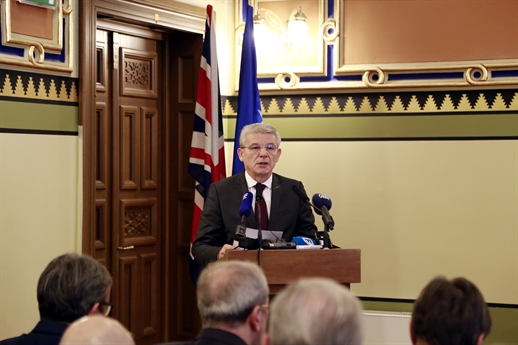
Ladies and gentlemen,
Bosnia and Herzegovina
lost its great friend. His homeland the United Kingdom lost its great
politician and diplomat, and the world lost a wise and a good man.
We have gathered today
to pay respects to him. He deserved it by his deeds.
He was born in 1941, in
the midst of the World War II, when the international order was fiercely disturbed
by the aggression, and when the whole nations were under threat of extinction. Until
the end of his life, Lord Ashdown was a great fighter for the values of the
free world.
When the aggression
against Bosnia and Herzegovina started in 1992, he was at the zenith of his
career as president of one of the leading parties in the British Parliament.
He recognized straight
away the importance of resistance against the forces of tyranny, which
conducted the aggression against our country and threatened our people with
extinction.
He arrived to the
besieged Sarajevo as early as in August 1992, met with the late President Alija
Izetbegović, and offered his support to a struggle fought by a free and
independent country, which symbolized defending the values of the free world.
Until the end of the war
he was one of the most ardent advocates of the international community's intervention
aimed at stopping the aggression and genocide.
It was by this
undertaking during the 1990's that he won the right to repeat, years later, the
truth that the genocide in BiH could have been stopped with more willingness
and decisiveness of the international community. “We could have prevented this
horror. We chose not to do so,“ he was saying and reminding the world.
Weighted down by quilt,
such awareness became the foundation of a more decisive engagement of the
international community in our country, particularly after the Dayton peace
agreement was concluded.
Lord Ashdown was indeed a
personification of such decisiveness.
In Bosnia and
Herzegovina we will remember him as High Representative, who made the unfair
Dayton peace a bit fairer through its correct interpretation and application
alike, thus making Bosnia and Herzegovina more functional in the interest of
all its citizens.
During his mandate in
Bosnia and Herzegovina between 20002 and 2006 some significant reform-driven
progress was made. Namely, the integration path of Bosnia and Herzegovina was laid
out to its membership in the European Union and NATO Alliance.
Forming of many state institutions
of Bosnia and Herzegovina is an important heritage of OHR during the Ashdown's
mandate.
During his mandate many
democratic institutions of the state of Bosnia and Herzegovina were either
formed or strengthened, as the basis for sustainable peace and security,
economic progress and the respect for human rights of all citizens and peoples
in BiH.
A single Armed Forces, a
single tax system, the state security agencies such as the Intelligence and
Security Agency (OSA) and the State Investigation and Protection Agency (SIPA),
as well as the state judicial institutions are just a part of the heritage for
which the citizens of Bosnia and Herzegovina have good memories of a joint work
of OHR, the Council of Ministers, and the Parliamentary Assembly of BiH from
that period.
A decisive initiative of
Lord Ashdown on the cooperation with the Hague Tribunal and on the persecution
of war criminals and their collaborators was particularly important.
The truth is that for
all his decisions he had a full political support of the overall international
community through the Peace Implementation Council. However, Lord Ashdown
provided a crucial contribution to the reforms by his energetic approach. These
reforms enabled us to have a much stronger state.
Lord Ashdown was a man
of action; a diplomat who gave priority to specific actions over being
concerned and restrained.
He knew that the
political forces which threatened the democratic values should be responded to
decisively and prevented from their destructive intentions.
On the occasion of
commemorating the 20th anniversary of the genocide, Lord Ashdown said that the
western world had to remember Srebrenica not only as a witness to such horror, but
also in order to understand what would happen when it turned its back.
This key lesson has
resonated by the power of its essential meaning: the international community
should not turn its back on Bosnia and Herzegovina.
Lord Ashdown did not
turn his back. He fulfilled his political mission, and, above all, his mission
as a human being.
He remained faithful and
selflessly committed to Bosnia and Herzegovina to the end. “I really love the Bosnian
people,“ he said in one of his last interviews.
Let us keep our memories
of him by fighting for Bosnia and Herzegovina, for freedom, truth and justice.
May our friend Paddy
rest in peace.