Ladies and Gentlemen,
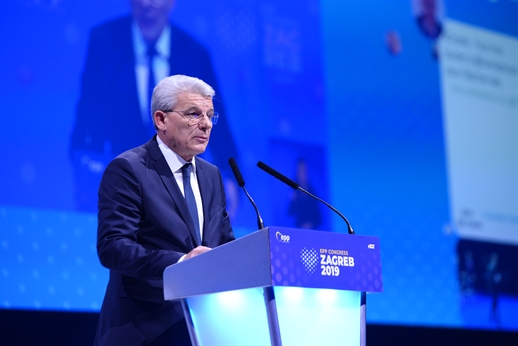
It is a great honor to be here today. President Tusk, thank you for everything you are doing for Bosnia and Herzegovina. Thank you for the leadership you show at protecting the values of the free world.
Esteemed
friends,
Our
time is a time of crisis. We first witnessed the economic crisis, then the
migrant and climate crisis, and now the unprecedented health crisis of our
generation. The crisis is beginning to be our permanent state.
It is
no longer news that we live in a time of tectonic movements. This was clearly
confirmed by the withdrawal of allied troops from Afghanistan. The collapse of
the institutions there and the humanitarian crisis which followed have raised
a number of questions. The vulnerability of the European Union on the global
stage has been shown. The discussion on the strategic autonomy of the European
Union is being renewed these days. The need for the EU to be a geopolitical
actor, not an object, is loudly emphasized.
If we
are talking about the geopolitical ambitions of the EU, then the first and most
important test is the Western Balkans.
The
mentioned global changes have already made a strong impact on the region. Some
local actors hope that the erosion of the current order could open room for
great "changes". This is primarily manifested in dangerous
territorial claims.
The
principle of immutability of borders is a cornerstone of European peace and
security. Two years ago, Chancellor Merkel's leadership action prevented the
dangerous idea of exchanging territories, which would have opened Pandora's box. The infamous
non-paper also showed that territorial aspirations are still alive. It is
encouraging that the international community has unanimously condemned the ideas of the non-paper,
identifying them as a threat to peace and the International order.
But it
is worrying that some local actors, even in Bosnia and Herzegovina, have dared
to openly support the non-paper ideas. And they still continue to promote them,
using increasingly aggressive secessionist rhetoric. They threaten European
peace and defy international law, encouraged by the crisis of the global order.
This phenomenon is so dangerous that one must not be silent about it. Because, it
is peace which is at stake.
If the
European Union wishes to be a geopolitical entity, then it must first address
these processes, which threaten peace in its immediate neighborhood. Resolute
action in the EU’s own backyard is the key condition for global credibility.
Ladies
and Gentlemen,
For
decades now, the European perspective has been the strongest framework for
strengthening peace and progress of reform in the Western Balkans. Numerous
steps have been taken thanks to the hopes and desires of the countries of the
region for membership in the European Union. The main reason for the raise of tensions
and instability in the region is the crisis of the European perspective.
The reason
behind the crisis is the increasingly frequent voice from coming from certain European Union countries, which dispute the
idea of enlargement.
A concrete confirmation of that atmosphere is the current blockade of Northern
Macedonia and Albania. After the spirit of compromise, which symbolized the
Prespa Agreement, was played out, the spirit of exclusivity in the region was
strengthened.
Recently,
an official from Bosnia and Herzegovina, at a political forum in a European
capital, stated that Bosnia and Herzegovina will never get a chance to become a
member of the European Union. And then, in line with his nationalist agenda, he
lashed out at the liberal values of the European Union.
I don’t
mention his name because it doesn’t matter. But what matters is the spirit it
symbolizes. By spreading despair over Europe's future, such actors are
relieving themselves of any obligation to respect democratic standards. Increasingly,
they openly refuse to implement the 14 recommendations of the European
Commission for Bosnia and Herzegovina. By shutting down the European
perspective, the main engine of positive movement is slowly being shut down.
All that remains is hopelessness and distrust, as a fertile ground for the
spread of fear and hatred.
Bosnia
and Herzegovina supports the Common Regional Market, within the Berlin Process,
we support regional economic and other cooperation, but nothing can be a substitute
for the perspective for the EU membership.
Ladies
and Gentlemen,
I do
not wish to make things look better than they are: the current situation in
Bosnia and Herzegovina is dangerous and worrying. State institutions have not
been functioning for several months, as Republika Srpska entity officials
refuse to attend sessions. They claim that the reason for that is Inzko's Law,
but that is not true.
A law
banning the glorification of war criminals and the denial of crimes is a law of
civilization. This is European law. European Union directives, as well as
judgments of the European Court of Human Rights, clearly state that the denial
of crimes and the glorification of criminals is not freedom of speech, but hate
speech.
Inzko's
law is not directed against any nation. It protects victims from all nations.
This law prohibits the denial of genocide and other crimes established by
judgments of International and domestic courts. This law prohibits the
celebration of war criminals regardless of their ethnicity or any other affiliation.
Inzko's
Law is not the reason for the current blockades in Bosnia and Herzegovina. It
is just an excuse. Republika Srpska politicians also had carried out blockades
months before Inzko's law. They have been conducting them for years, finding various
reasons and excuses. Yesterday, these were decisions of the Constitutional
Court that were not to their liking; today it is Inzko's Law or the election of
a new High Representative; there will be something else tomorrow. And the real
reason and goal is always the same: to block the functioning of the state, to
create the idea that he state is impossible and to demand its disbandment, in
accordance with the secessionist agenda, which is not about peace and progress,
but some goals from past centuries.
Esteemed
Friends,
Any
state, whose highest officials would not come to the sessions, would not be
able to function. It is not the fault of the state, but of those officials. The
only difference between European countries and Bosnia and Herzegovina is that
we do not have a domestic mechanism for sanctioning such blockades.
The
Dayton system envisages that the High Representative will be an instance that
will determine the responsibility of officials who obstruct the work of
institutions, and thus the implementation of the Dayton Agreement. The process
of making the position of the High Representative passive, which we have been
witnessing for a long time, or its removal, which some advocate - would have
fatal consequences. This would upset the Dayton balance. Numerous blocking and
obstruction mechanisms would remain in the system, and the only unblocking
mechanism would be removed.
The
Office of the High Representative is not a precedent of any kind, but a
necessary occurrence in societies where there have been serious violations of
international law. In Germany and Austria, after the Second World War, there
was the Allied Control Council, which had significantly greater powers than the
OHR, and passed laws even, including those on the basis of which war criminals
were prosecuted.
This
did not prevent these countries from becoming members of the European Union and
the countries that serve as an example today. On the contrary.
That
Control Council was abolished after Germany united. This should be a signpost
for Bosnia and Herzegovina. Once internal cohesion and functionality are
achieved, Bosnia and Herzegovina will be able and have to function
independently.
Ladies
and Gentlemen,
Building
a functioning state is the biggest challenge for Bosnia and Herzegovina. In
that sense, one of the key initiatives is the one for the implementation of the
judgments of the European Court of Human Rights in Strasbourg, as one of the 14
priorities from the Opinion of the European Commission.
The
Sejdić-Finci Ruling does not seek to increase the sense of representation of
the constituent peoples in the Presidency, as some suggest. On the contrary,
the European Court has found that constituent peoples already have more rights
than others. It can even be said that they are privileged in relation to
others. That is why the Court asked Bosnia and Herzegovina to ensure equal
rights for citizens who are not members of the constituent peoples.
If now,
regardless of the Ruling, the condition is to further increase the sense of
representation of one constituent people in the Presidency of BiH, then we are
not talking about the implementation of the Strasbourg Court Ruling, but about
changing the Dayton Agreement and its balance. In that case, it is then
necessary to reduce the possibilities of ethnic veto in parliaments. In
particular, it is necessary to reduce the House of Peoples of the Federation of
BiH to the status of the Council of Peoples in RS.
The
biggest frustration is not in the feeling of underrepresentation of the constituent
peoples, but in the feeling of helplessness of the majority of citizens before
the fact that ethnic clubs in parliament can block the adoption of any law,
even those that have nothing to do with national identity or a specific issue.
Specifically, in the House of Peoples of the Federation, an ethnic club has
been blocking the election of a new government and the appointment of judges in
the Constitutional Court for three years.
It is
impossible to talk about the frustrations of any constituent people, if we do
not solve the stated frustration of all citizens. It is impossible to talk
about a compromise solution without taking into account the demands of all
actors. It is pointless to demand the fulfillment of the demands of one
political party, and to ignore all the others. Compromise is the only solution.
Everything else is a dead end.
Ladies
and Gentlemen,
On this
occasion, I would like to thank the European People's Party for consistently
advocating the policy of EU enlargement.
The
Western Balkans needs the European Union, but the European Union also needs the
Western Balkans. Any postponement of the enlargement indefinitely or
challenging the idea of the enlargement - can only lead to destabilization, stagnation in reforms, and an increase
in the influence of other forces in this area. This is certainly not in the
interest of either the citizens of the Western Balkans or the citizens of the
European Union.
That is
why it is very important that we continue as strongly as possible and that we
complete the process of full integration of all the countries of the Western
Balkans into the European Union as soon as possible. It is for important for a
more peaceful and prosperous Western Balkans and for the sake of a more
peaceful and prosperous European Union.
Thank
you.