Ladies and Gentlemen,
Resident Coordinator Macdonald,
Your excellences!
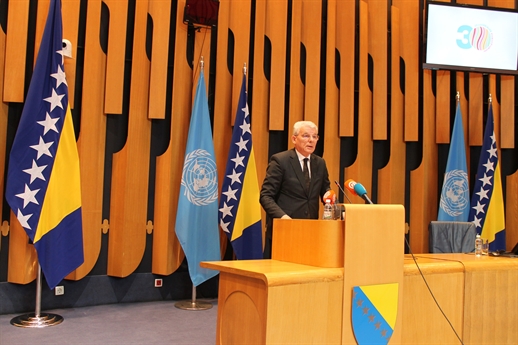
It is a great pleasure to address you on the occasion of this important jubilee. On this day, 30 years ago, Bosnia and Herzegovina became a member of the United Nations. The flag of Bosnia and Herzegovina was raised in front of the East River building, along with the flags of Slovenia and Croatia.
That was one of the most significant moments in our history, it was solemn, but we did not celebrate. We could not. We were forced to fight for freedom, independence, but also for democracy as we were facing huge sacrifices already.
The international community had accepted the fact that international law is at the foundation of our statehood. Admission to the United Nations was the final stamp on that viewpoint. The highest standards of international law determined the path that had been consistently and transparently met in declaring our independence. Citizens of Bosnia and Herzegovina, almost two-thirds of them, of all ethnicities, showed political maturity, responsibility in the face of history and generations to come and voted for independence on February 29 and March 1, 1992.
The international community accepted this, and the whole world recognized Bosnia and Herzegovina. The government of Bosnia and Herzegovina, under unimaginably difficult circumstances, ensured that, in addition to individual recognitions, Bosnia and Herzegovina was affirmed at the multilateral and global level. We entered the world stage on May 22, 1992, with the UN Resolution No. 757, and since then our intensive and meaningful relationship with the UN Organization and its agencies has continued. Thirty years of membership deserves a much more detailed and meaningful review, but allow me to iterate the following in the shortest terms.
The international recognition of Bosnia and Herzegovina and simultaneous admission to the UN was an important and irreversible diplomatic act. The symbolic message of the international community and the UN that it stood with Bosnia and Herzegovina's independence, however, was brutally tested on the ground in Bosnia and Herzegovina itself, but also in international forums where the act of international recognition and admission to the UN would become an important capital of the war-torn state. The UN membership was of key significance. There are only a few countries in the world that have had such a historic disaster as Bosnia and Herzegovina that their mere survival depended on the UN, and to be among those who experienced the consequences of the inefficiency of the UN system on the ground.
Although the UN has had many successes and failures in peacekeeping operations during its existence, only the tragic scale of crimes and genocide in Bosnia and Herzegovina, and also in Rwanda, would affect changes in the institutional culture of "peacekeeping" developed by the UN Secretariat and which had not recognized the possibility of humanitarian intervention to protect civilians from crimes against humanity.
Bosnia and Herzegovina, in a specific international context, can be described as a victim of the passivity of the international community, but by no means only as an object but a state that has shown exceptional, even unprecedented intensity of diplomatic activity. We have failed to reform the UN, or to change the post-Cold War state of relations in the international community, and, unfortunately, this is a process that still remains to be completed.
However, even the subtle changes in the course of this cumbersome global mechanism, reflected in the consideration and introduction of new concepts of protection of civilians in war conflicts, international punishment of crimes and, in particular, sexual crimes against women, can be considered significant global diplomatic successes of Bosnia and Herzegovina. Countries with much greater foreign policy capacity would have found it difficult to accomplish such changes.
Allow me also to point out the fact that each of the 55 UNSC resolutions from this period, which refer to Bosnia and Herzegovina and the situation in the former Yugoslavia, was very clear and precise in terms of describing the situation and events on the ground. This would prove extremely important for determining the character of the war in Bosnia and Herzegovina, which at that time was interpreted differencly.
The diplomatic mission of Bosnia and Herzegovina to the UN was, of course, among the first and most important diplomatic missions of Bosnia and Herzegovina and, let me highlight, the contribution of the mission had in the formation of the International Criminal Tribunal for the former Yugoslavia. The Hague tribunal and its attitude towards it, even after its formal closure in November 2017, remained a measure of political decency and emancipation from the aggressive nationalism of the 1990s for all countries of the former Yugoslavia. Based on that experience, Bosnia and Herzegovina was an active participant in the establishment of the International Criminal Court.
Global visibility and experience gained by Bosnia and Herzegovina in the early 1990s would prove to be a very important political and diplomatic resource even in years when Bosnia and Herzegovina was no longer high on the agenda of international issues, and when faced with a different position in the UN - the one all other countries enjoy, and whereby, given the size and capacity of Bosnia and Herzegovina, it is very difficult to be noticed.
Although the intensity of diplomatic activities has been reduced to a regular, peacetime level, Bosnia and Herzegovina has remained, for a country of its size and foreign policy capacity, a very visible, committed and active member of the United Nations. One part of these activities is still related to cooperation with the UN and UN agencies in the implementation of the Dayton Peace Agreement, and the impact and shaping of the UN engagement, because Bosnia and Herzegovina has remained, to this day, one of the topics at UN Security Council meetings.
The second part of our diplomatic activities is dedicated to sharing experiences in conflict and post-conflict situations. In the UN environment, I can convey this to you first hand, and the BiH ambassadors present at the UN can confirm this, the fact that is especially appreciated is that in less than ten years since the end of the war, Bosnia and Herzegovina moved from a country which hosted international military forces to the category of a state participating in peacekeeping missions.
Bosnian-Herzegovinian troops were part of peacekeeping missions in Afghanistan, Congo and Mali, and police officers in Cyprus, and in Liberia, South Sudan, Afghanistan, Somalia and the Central African Republic. So far, more than 2,000 troops and several hundred police officers have participated in UN peacekeeping missions.
Our engagement in the UN and the attitudes we have promoted have best confirmed that we share the principles and values of the UN Charter.
This was recognized and rewarded with the greatest diplomatic success of BiH - membership in the UN Security Council in the period 2010-2011 as a non-permanent member. It is a source of great pride for Bosnia and Herzegovina that 174 UN members voted FOR its non-permanent membership in the UN Security Council.
Furthermore, perhaps more importantly, the two-year term in this "global government" meant that Bosnia and Herzegovina experienced new foreign policy and diplomatic challenges, to which we, united as rarely we were, successfully responded. The intensity and content of our diplomatic activities confirmed Bosnia and Herzegovina as an equal and competent partner in the international community, and an actor whose diplomatic performance is often well above objective foreign policy capacities. We can also thank our outstanding ambassadors and mission staff for this.
Ladies and Gentlemen,
We have shown visibility and commitment in many other UN bodies, as well as in Bosnia and Herzegovina itself, through active and successful cooperation with UN agencies. Our view of the UN is realistic and balanced - we understand and see the difficulties and global challenges facing the UN, but we also recognize the value of these goals and the need for humanity to make this organization a success. That is why we remain committed to these principles and goals and we want to share our experience and offer our full contribution.
Our position in the United Nations is determined by universal trends of intensifying globalization and interdependence, realistic foreign policy capacities of Bosnia and Herzegovina, harmonized foreign policy goals of BiH, sustainable development goals, and high intensity of diplomatic activities of our missions in the United Nations. Therefore, I firmly believe that Bosnia and Herzegovina will continue to consistently fulfill its obligations and exercise its rights as a full member of the United Nations.
Finally, on the occasion of the 30th anniversary of Bosnia and Herzegovina's accession to the United Nations, allow me extend my words of gratitude and sincere congratulations to all officials and international officials of the UN and its agencies, international and local staff of the UN and UN agencies in Bosnia and Herzegovina, UN volunteers, as well as Bosnian-Herzegovinian ambassadors and diplomats who, with their professional and personal engagement, have contributed to successful membership in these 30 years.
I invite you to continue working daily with the younger generations to the benefit of Bosnia and Herzegovina, and to promote peace, cooperation and sustainable development in the United Nations community.