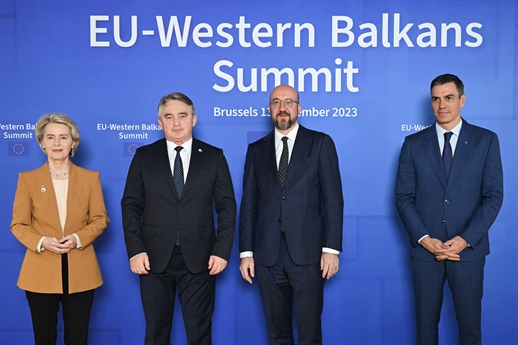
Dear President of the European Council,
Your Excellencies,
Ladies and Gentlemen,
I am grateful for the invitation to another summit of the
European Union and the countries of the Western Balkans. I think it is very
important to maintain the continuity of talks at the highest political level.
We are still in a very complex geopolitical moment for
Europe, caused by Russia's aggression against Ukraine. The situation is further
complicated by Israel's disproportionate military response to Hamas' terrorist
attack on Israeli civilians.
The level of indiscriminate destruction and killing of
Palestinian civilians in Gaza has caused great turbulence in Europe and the
world, and has also affected relations in the United Nations and the
functioning of its institutions.
Emotions capable of raising tensions cannot be localized to
regions of conflict. Media and social networks transmit emotions to other parts
of the world with uncertain outcomes.
In this geopolitical context, we are discussing today, here
in Brussels, the further direction of the integration of the Western Balkans
into the European Union.
This is good, because the active role of the European Union
and its political presence can thwart potential intentions to provoke conflict
situations that could lead to escalation in our region as well.
I think that escalation does not suit anyone reasonable in
the region. Therefore, let us start talking about revitalizing the perspective
offered to the Western Balkans by bringing it closer to the European Union.
From the perspective of Bosnia and Herzegovina, it is clear
to us that our candidate status, acquired a year ago, as well as the recent
conditional recommendation of the European Commission for the opening of
negotiations with Bosnia and Herzegovina, is the result of the tense
geopolitical situation on the borders of the European Union and that obtaining
candidate status has absolutely nothing to do with meeting the standards and
realizing the assumed obligations.
Nevertheless, I certainly want to thank the Commission and
the Council for their positive attitude towards Bosnia and Herzegovina.
I would like to be able to say that the progress in the EU
integration status of Bosnia and Herzegovina is the merit of the institutions
of Bosnia and Herzegovina. Unfortunately, the effort to adopt legislation and
build the professional capacities of the state administration is not satisfactory.
Our public opinion is aware of this. The survey from 2023
shows that 73.3% of citizens still support the European integration of Bosnia
and Herzegovina, which is 4.1% less than in 2022, while the survey from 2022
shows that only 42% believe that BiH will become part of the EU by 2030, and
13% believe that it will never happen.
I still believe that the fulfilment of 14 key priorities
from the Opinion of the European Commission from May 2019 is crucial for
further progress of our country in the direction of harmonization with the EU
acquis.
I appeal to all EU institutions, as well as to the member
states that the so-called 14 priorities from the European Commission Opinion
from 2019, which concern Bosnia and Herzegovina, still remain a kind of
official policy of the European institutions towards Bosnia and Herzegovina.
That relationship and that policy must be freed from any kind of hypocrisy on
all sides.
The last intensive dialogue of the European Commission with
representatives of the legislative and executive authorities in Bosnia and
Herzegovina, the Council of Ministers of Bosnia and Herzegovina, entity and
cantonal governments, in accordance with the established coordination mechanism
within BiH, which the Commission also accepted as a working method, caused, to
put it mildly, ridicule in BiH public.
The public of Bosnia and Herzegovina saw that meeting as an
obvious proof of the dysfunctionality of Bosnia and Herzegovina as a state, but
also as proof of the dysfunctionality of the coordination mechanism itself and
the relationship to the EU integrations of both the EU and Bosnia and
Herzegovina.
Nevertheless, that method of work is officially and mutually
accepted, and because of this, the legislative and executive bodies of all
levels of government in Bosnia and Herzegovina are obliged to play an active
role in the implementation of reform processes.
In this regard, the "Growth Plan" for the Western
Balkans can be an important support for reform processes, but also for the
preservation of pro-European commitment in the circumstances of a pronounced
propaganda war aimed at destroying "European values", not only in the
Western Balkans but also in the European Union itself.
I am aware that the Council of Ministers of Bosnia and
Herzegovina submitted the draft "Reform Plan" for Bosnia and
Herzegovina to the Commission last week. The document briefly includes: green
and digital agenda, development of the private sector and business environment,
preservation and development of human resources and the rule of law.
In the next month or two, governments and legislative bodies
of all levels of government in Bosnia and Herzegovina should show concrete
progress in this direction.
In this regard, I expect the responsible officials to fulfil
the obligations they have assumed, including the obligations that the leaders
of the political parties assumed at the meeting with you, President Michel,
exactly 18 months ago, in this same place.
Finally, concrete regulations, standards and procedures are,
at first glance, far from their sphere of interest. I would therefore recommend
that the European Union pay attention to the preservation of "European
values" as a type of emotional aspect of integration that is often
neglected, but turns out to be very important.
Underestimating the subjective attitude of citizens towards
the value system on which the EU is based can lead to those citizens giving up
on the European Union. Ultimately, the value system that we believe still exists
in the EU makes us in Bosnia and Herzegovina determined to be part of the EU.
Giving up those values will turn BiH society away from the
EU itself, and the EU will gain another source of instability on its borders.
Here, above all, I mean support for the elimination of
discrimination based on religious, ethnic, racial, political or any other
affiliation, which is guaranteed by the European Convention on Human Rights and
Fundamental Freedoms, which is an integral part of our Constitution.
Therefore, in the context of the rule of law, as one of the
reform priorities from the draft "Reform Plan" of Bosnia and
Herzegovina, I believe that the implementation of the six judgments of the
European Court of Human Rights in the cases of Sejdić-Finci, Pilav, Zornić,
Šlaku, Pudarić and Kovačević is pivotal.
The geopolitical moment does not allow further
procrastination and avoiding the truth, that the actual implementation of these
judgments is inevitable. Only if the European Union, clearly and unequivocally,
stands behind the necessity of realizing "European values" and the
rule of law in Bosnia and Herzegovina, we can get a synergy of
"emotional" support for European values, practical visibility of the
"Plan for Growth" and a real will for reforms that will further
direct Bosnia and Herzegovina towards her European goal.